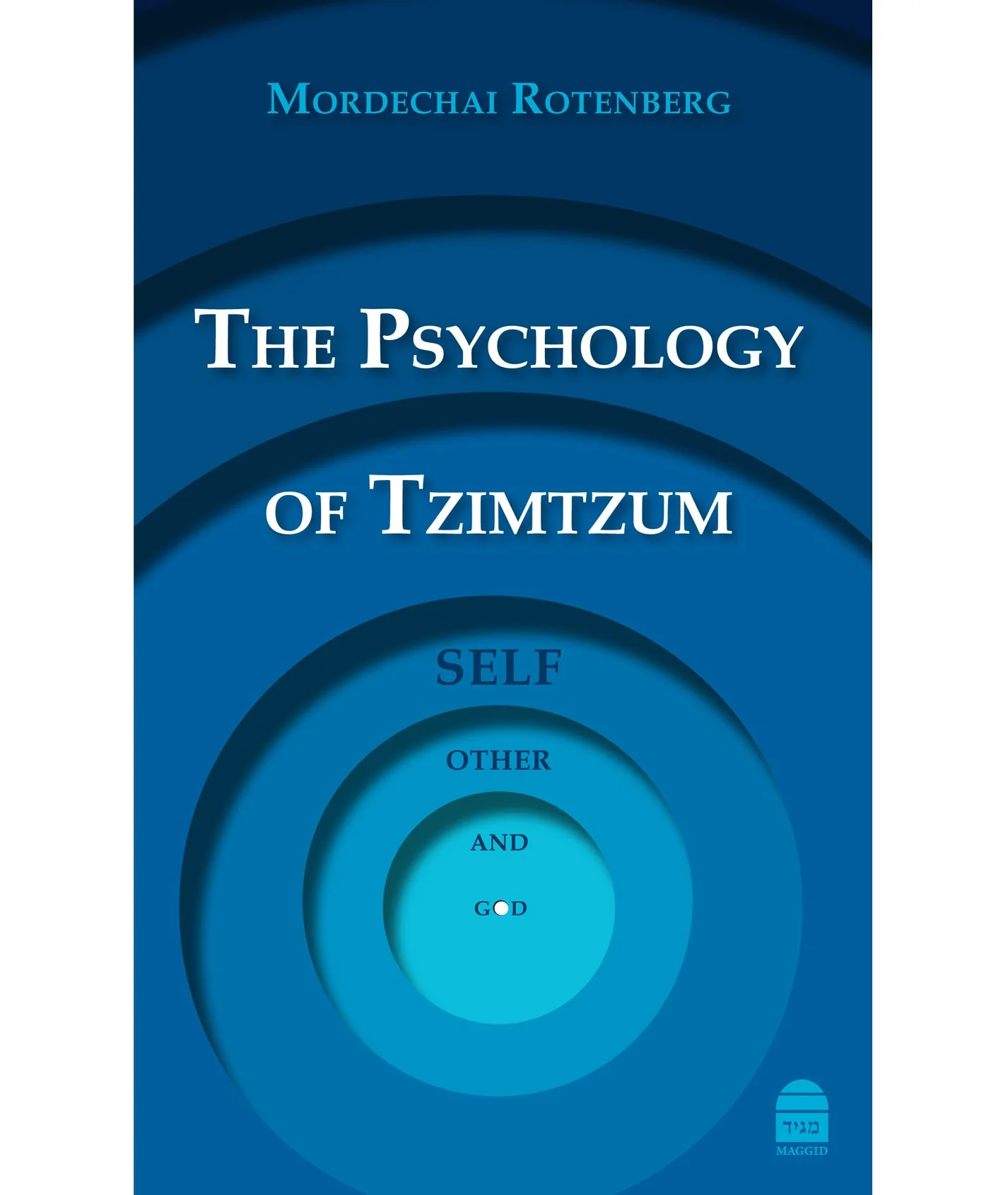
The Psychology of Tzimtzum
Western psychology often describes relationships – between parent and child, individual and society, man’s physical and spiritual urges – as a complex set of conflicts, an ongoing struggle for dominance. In The Psychology of Tzimtzum , Professor Mordechai Rotenberg seeks to establish an alternative: a Jewish psychology, based on the kabbalistic concept of Tzimtzum (self-contraction). God’s primordial act of Creation, contracting Himself to make room for the world, becomes for Rotenberg a model for all human interaction. When the self contracts to make room for the other, the resulting relations are ones of dialogue rather than conflict, self-effacement rather than self-assertion, a desire to give rather than a desire to destroy.
The Psychology of Tzimtzum introduces the groundbreaking thought of Israel Prize laureate Professor Mordechai Rotenberg, the founding father of Jewish psychology.
Western psychology often describes relationships – between parent and child, individual and society, man’s physical and spiritual urges – as a complex set of conflicts, an ongoing struggle for dominance. In The Psychology of Tzimtzum , Professor Mordechai Rotenberg seeks to establish an alternative: a Jewish psychology, based on the kabbalistic concept of Tzimtzum (self-contraction). God’s primordial act of Creation, contracting Himself to make room for the world, becomes for Rotenberg a model for all human interaction. When the self contracts to make room for the other, the resulting relations are ones of dialogue rather than conflict, self-effacement rather than self-assertion, a desire to give rather than a desire to destroy.
The Psychology of Tzimtzum introduces the groundbreaking thought of Israel Prize laureate Professor Mordechai Rotenberg, the founding father of Jewish psychology.
Description
Western psychology often describes relationships – between parent and child, individual and society, man’s physical and spiritual urges – as a complex set of conflicts, an ongoing struggle for dominance. In The Psychology of Tzimtzum , Professor Mordechai Rotenberg seeks to establish an alternative: a Jewish psychology, based on the kabbalistic concept of Tzimtzum (self-contraction). God’s primordial act of Creation, contracting Himself to make room for the world, becomes for Rotenberg a model for all human interaction. When the self contracts to make room for the other, the resulting relations are ones of dialogue rather than conflict, self-effacement rather than self-assertion, a desire to give rather than a desire to destroy.
The Psychology of Tzimtzum introduces the groundbreaking thought of Israel Prize laureate Professor Mordechai Rotenberg, the founding father of Jewish psychology.